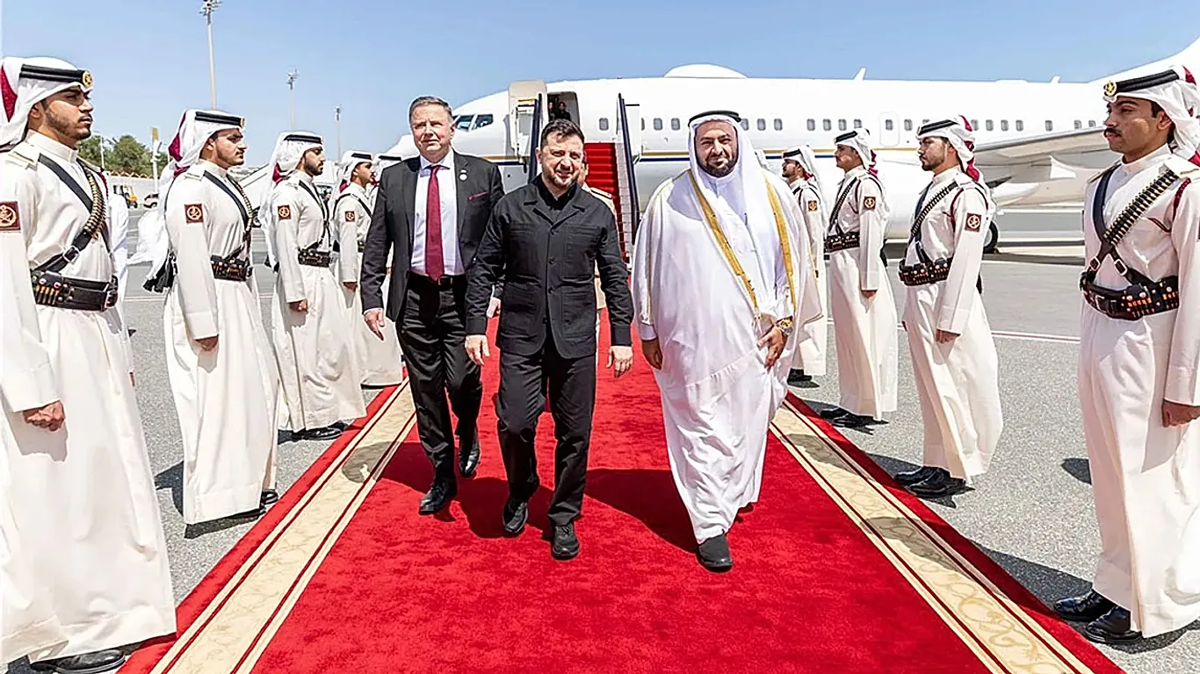
After passing through Saudi Arabia and the United Arab Emirates, the head of state landed in Qatar amid the regional escalation sparked by the war with Iran, with a dual objective: to offer concrete cooperation in drone defense and, at the same time, open new channels of political, military, and energetic support to sustain the Ukrainian effort against Russia. The visit was not merely a protocolary gesture. This condition as a reliable mediator gave Zelensky's visit a special density: in Qatar, Ukraine is not just seeking systems, agreements, and fuel, but also an interlocutor with regional and international reach at a time when the global chessboard has become much more unstable. Thus, the stopover in Doha sends a clear political signal. Zelensky is attempting to transform the tragedy of war into a tool for strategic insertion: to offer accumulated military know-how in exchange for support, financing, technology, and greater diplomatic density. The conflict with Iran has lasted a month and has begun to alter markets, energy routes, and Western military priorities, generating fear in Kyiv that part of the political focus and material support could shift from the Ukrainian front to the Middle East. Days earlier, Zelensky had closed another military cooperation agreement in Saudi Arabia, showing that the tour was not just political: it aimed to build a concrete network of agreements with the Gulf monarchies, which today feel exposed to the Iranian threat and value the combat experience accumulated by Ukraine. The background is clear. Kyiv has been offering several Arab countries technical assistance to improve the interception of drones and missiles, a capability it developed under real fire after more than four years of Russian invasion and facing the massive use of Iranian-designed Shahed drones. For Qatar, the UAE, or Saudi Arabia, the Ukrainian war has ceased to be a distant conflict and has become a laboratory for defensive solutions tested in extreme conditions. In the case of Qatar, moreover, its relationship with Ukraine has a prior basis that goes beyond the military. Doha had already become a relevant actor in the humanitarian dimension of the war, mediating for the return of Ukrainian children taken to Russia or occupied territories and participating in humanitarian exchanges between the two countries. In previous statements, Zelensky also made it clear that this help is not philanthropic: Ukraine is seeking money, technology, and, above all, access to high-end anti-aircraft missiles that it urgently needs to protect its cities. This calculation has become even more urgent due to the new international scenario. In this context, Zelensky's tour of the Gulf also functions as a repositioning maneuver: if the world is looking more towards the region, Ukraine is trying to be present there not just as a victim of an invasion, but as a useful partner in security. The bet also has a practical dimension. AP reported that while Zelensky was touring the Gulf countries, Russia launched 273 drones against Ukraine in a single night, of which 252 were shot down or electronically neutralized. The President of Ukraine, Volodymyr Zelensky, arrived this Saturday in Doha on the most delicate and at the same time most ambitious leg of his tour of the Gulf, a diplomatic offensive with which Kyiv seeks to turn its war experience into an exportable strategic asset. In a world traversed by interconnected wars, this could be one of the smartest moves Kyiv has today to not be cornered by the noise of other fronts. This data not only once again shows the intensity of the Russian attack: it also explains why Ukrainian experience began to be valued in a region that today faces similar threats. Zelensky himself had explained that Ukraine had sent more than 220 specialists to advise countries in the region, while other teams were continuing their journey to Jordan and Kuwait. In other words, Ukraine is no longer presenting itself only as a country that asks for help, but as an actor that can sell experience, share capabilities, and forge useful alliances in a convulsed region. Foreign Minister Andrii Sybiha openly stated that 'everything is interconnected' and warned that Ukraine cannot afford to lose global attention just when it is trying to maintain pressure on Moscow. According to Reuters, Ukraine and Qatar reached a defense cooperation agreement focused on exchanging experience to counter missiles and unmanned aerial systems, while in the UAE, progress was also made on understandings in security and defense.